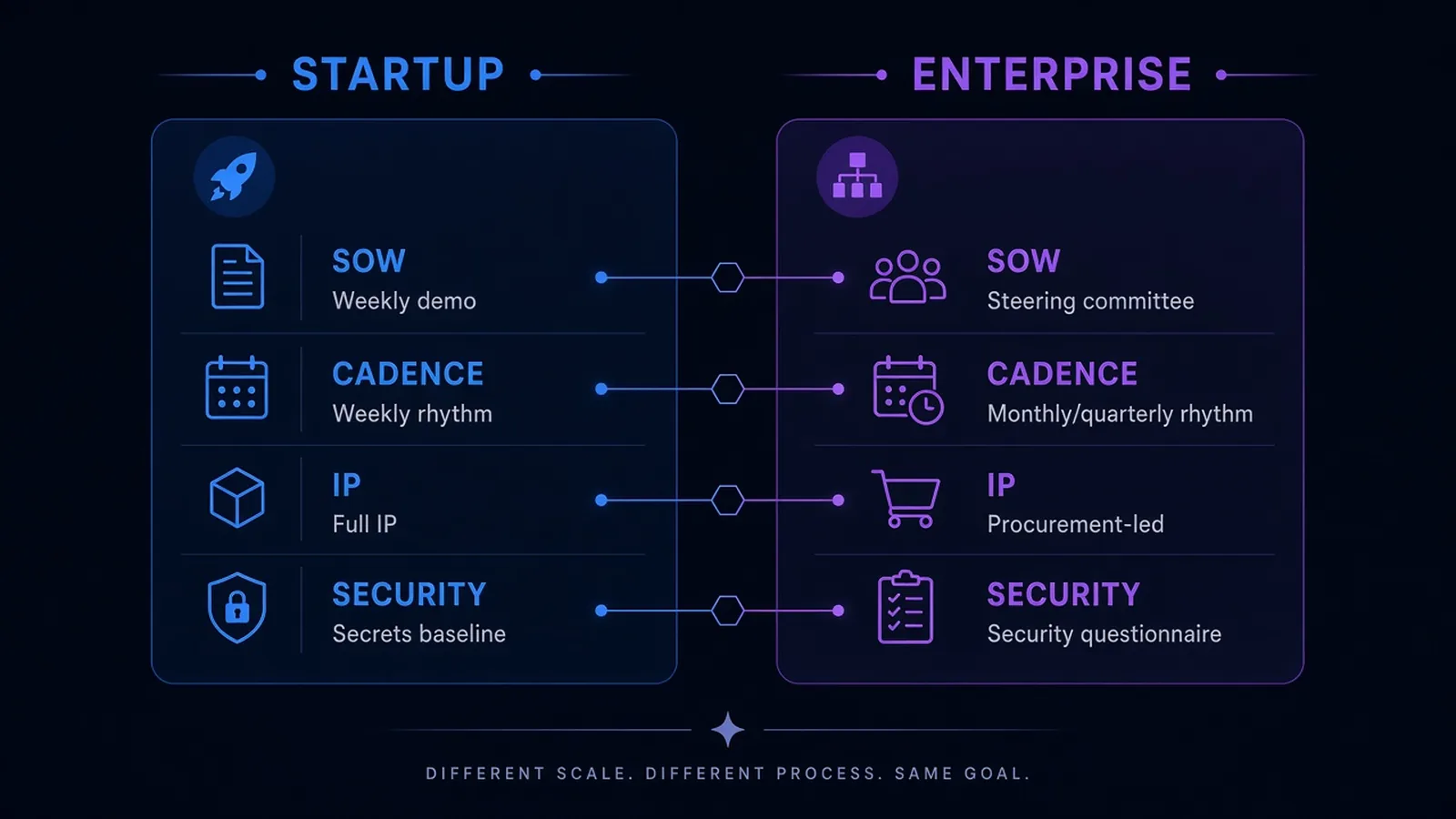
Buyers often ask whether Myrafy "does startups or enterprise." The honest answer is both, with different contracts and rituals. The code can look similar. The way you approve work, accept risk, and talk to legal should not.
This is a map of those differences - not a claim that one side is more serious. A three-person product can need production-grade auth. A large company can need a four-week slice, not a 40-person program.
We publish the two paths on the site as MVP builds vs longer partnerships. Here is how to choose without wasting a quarter on the wrong wrapper.
What Is Actually Different
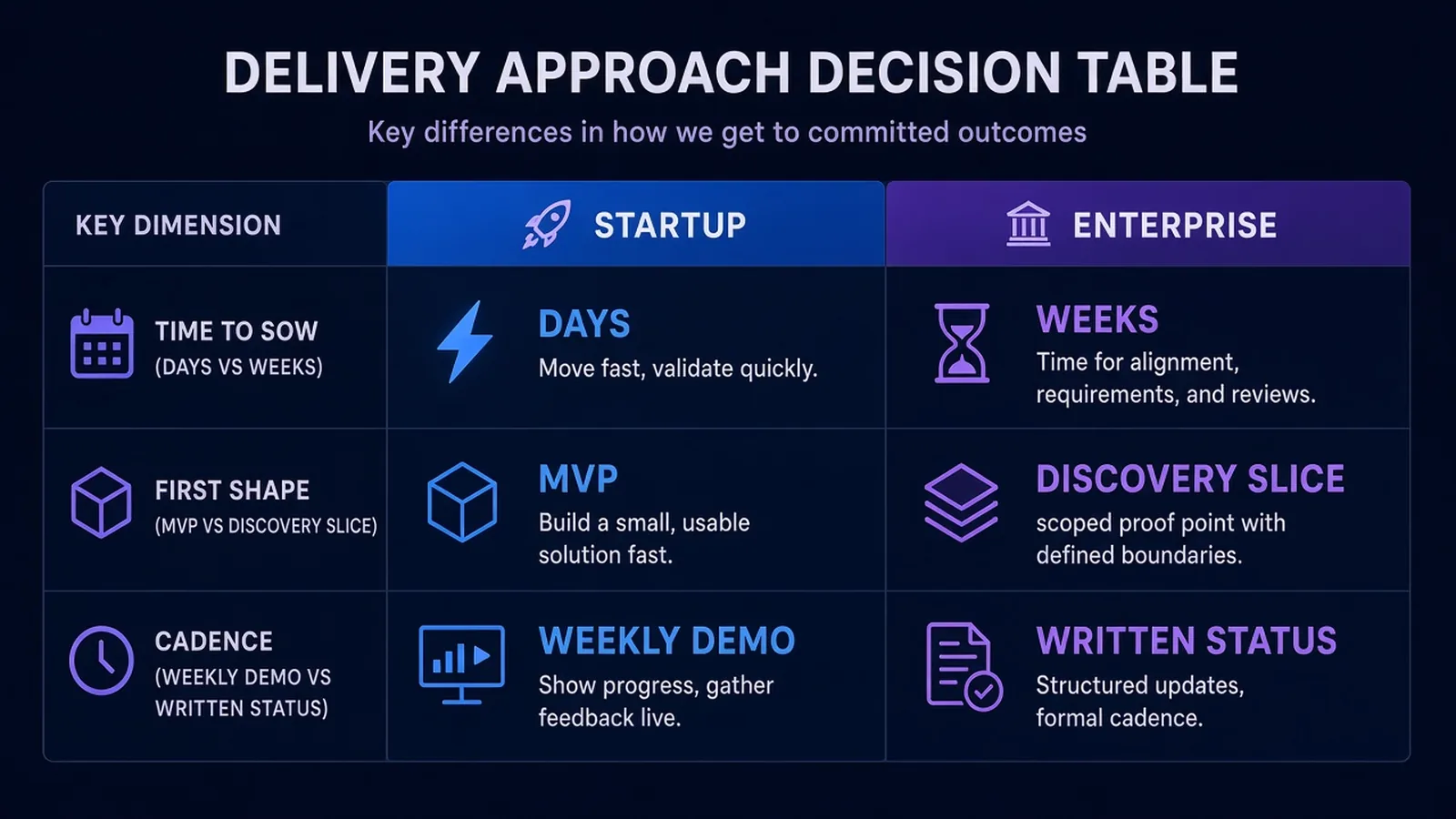
| Startup / product team | Enterprise / platform team | |
|---|---|---|
| Decision maker | Founder or head of product | CTO, procurement, security, sometimes a steering group |
| Time to first SOW | Days, if the brief is tight | Weeks - NDA, vendor onboarding, info-sec questionnaire |
| Typical first shape | Fixed-scope MVP or milestone build | Discovery, audit, or a defined slice inside a larger estate |
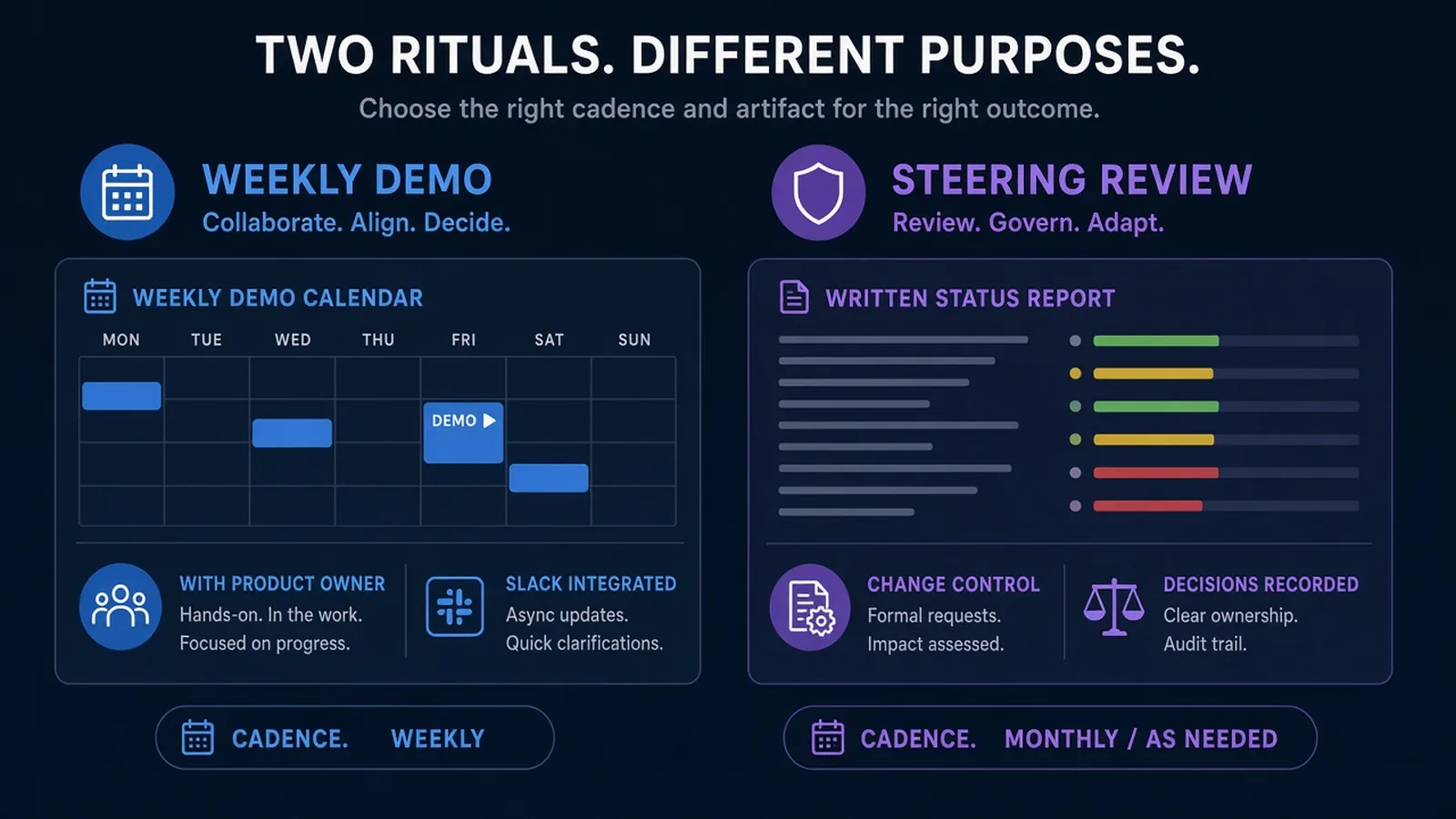
| Cadence | Weekly demo, Slack, fast decisions | Sprint reviews, written status, change control |
| Risk that dominates | Building the wrong product | Operational, security, and vendor risk |
| After launch | Retainer or pause | Retainer, team extension, or a second SOW |
The engineering bar - tests, CI, secrets, observability - should not drop for startups. What drops is ceremony you cannot staff.
Startups: Optimize for Learning With a Ceiling
Early products change after the first real users. That is why hourly or hybrid billing is common - but "hourly with no owner" is how runway disappears.
What works:
- Paid discovery if the brief is still a pitch deck
- Milestone fixed price when screens and APIs can be listed
- Weekly demos in the product owner's calendar, not a monthly reveal
- Your repo from day one, full IP at handover (this is how we work on company process)
What to avoid:
- Buying a six-month "team" when you need a twelve-week MVP
- Agency-style account layers between you and the people writing code
- Unverifiable promises ("we've shipped 200 startups"). Ask for a method, a sample SOW, and who will actually be on the work.
Rate context for India-based senior delivery is in custom software cost and MVP cost in India. Use ranges as planning tools, not as a bid.
Enterprise: Optimize for Procurement Without Diluting Delivery
Enterprise buying is slower because more people can say no. That is rational if you run payroll, health data, or a public portal.
What works:
- An NDA first, then a short technical workshop, then a SOW - not a 40-page RFP that nobody will implement as written
- Named engineers on the statement of work, not a logo and a bench
- Info-sec answers that match the actual architecture (SSO, logging, data residency) rather than a generic "we are ISO-everything" slide
- Phased cutover for legacy work (digital transformation is a program of slices, not a weekend rewrite)
- Direct contracts when your policy allows - fewer middlemen, clearer IP
What to avoid:
- Staffing bait: seniors in the pitch, juniors on the RAID log
- A single "AI platform" SOW with no corpus, no evals, no ACL model (production AI checklist)
- Measuring the partner only on slide throughput. Measure demos, merged code, and incident behavior.
Government and regulated buyers: we take documentation and access control seriously; we do not pretend to run your program or your compliance function. Industry notes live on industries.
Shared Rules (Do Not Negotiate These Away)
Regardless of badge on the invoice:
- Written SOW with acceptance criteria
- Source in your Git host
- Secrets out of git (working pattern)
- A demo cadence someone actually attends
- A change log for out-of-scope asks
If a vendor will not do those for a startup or an enterprise, the engagement model is a distraction.
Models We Use on Both Sides
From how we work:
- Fixed-scope project - MVPs, migrations with a known source, a feature with edges
- Hourly / time & materials - spikes, audits, fuzzy integrations, with a cap when finance needs one
- Monthly retainer - post-launch product, AI ops, cloud care
- Dedicated team extension - senior engineers inside your ceremonies for months, not a staff-aug cattle call
Startups usually enter through the first two. Enterprises often enter through discovery or a slice, then retainer or extension if the fit is real.
How to Brief Us (or Anyone Like Us)
If you are a product team: problem, users, must-have for v1, deadline, budget band, existing stack. A loom of the current tool beats a 20-page vision doc.
If you are a platform / procurement lead: systems in play, constraints (SSO, data, vendor questionnaires), success metric for the first SOW, who signs, and who will be the day-to-day owner. We cannot replace a missing owner with process.
Typical estimate response is within one business day once those exist - ranges first, a priced SOW after discovery when the unknowns are still large.
The Bottom Line
Startup vs enterprise engagement is paperwork, cadence, and who can say no - not a different definition of "done." Startups need a ceiling and learning. Enterprises need a vendor they can onboard and an architecture they can defend. Senior engineers belong on both.
Pick the smallest contract that produces a demoable increment in your repository. Grow the relationship after that, not before.
Building an MVP or a platform slice? See Myrafy services or contact us for a free estimate - we will say if the work wants discovery, a fixed SOW, or a retainer.