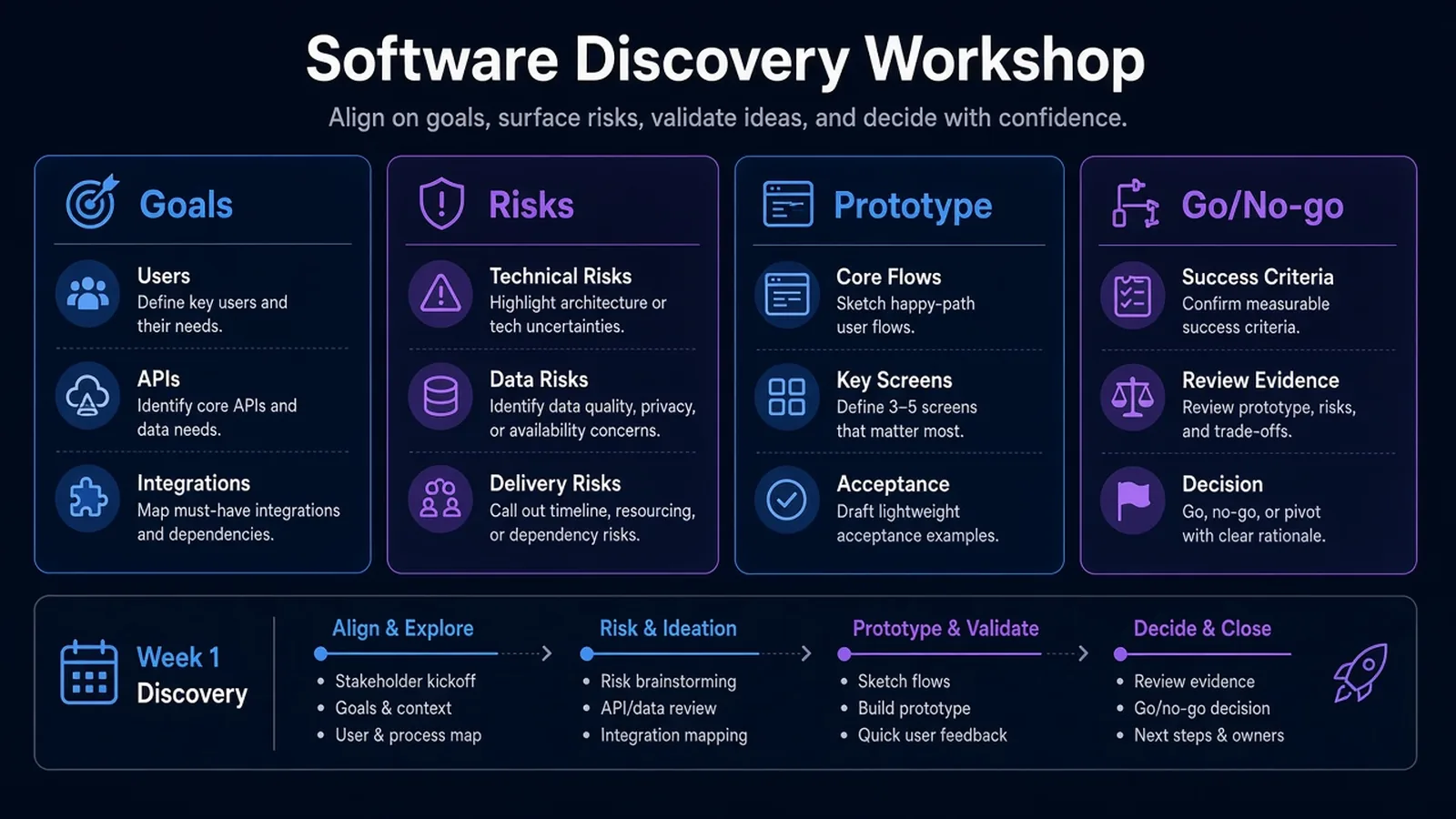
Most software overruns start before a line of production code. The brief is a slide, a competitor URL, and "we'll figure it out in sprint one." The vendor then either pads a fixed price until it hurts, or starts the meter while everyone is still arguing about users.
A paid discovery is the cheaper middle: a time-boxed piece of work whose job is to make the next contract honest. It is not a free sales workshop, and it is not an unpaid "we'll get back to you with a quote."
This is how Myrafy treats discovery when we scope software work - and how you should evaluate it from any senior engineering company.
What Discovery Is For
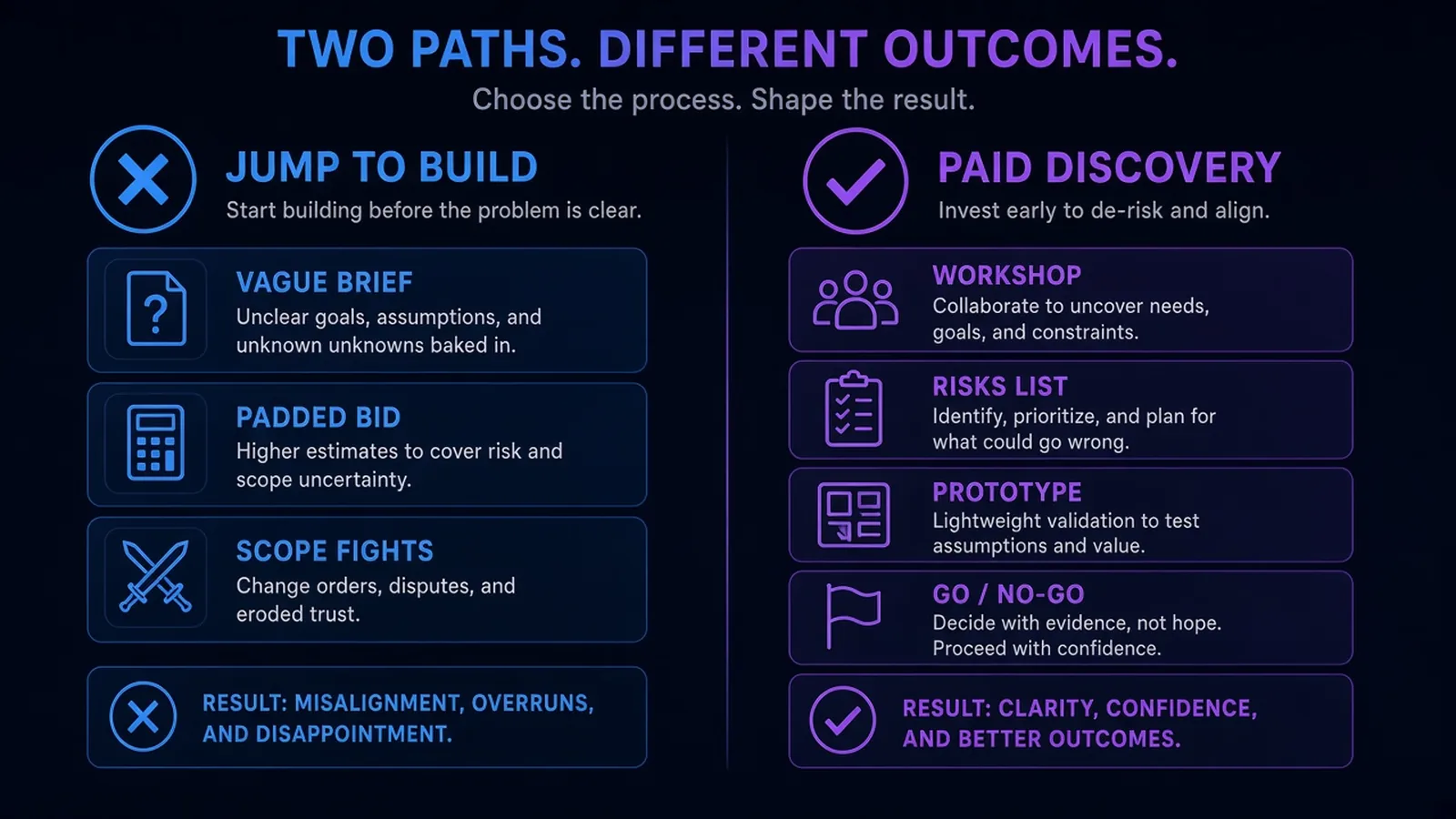
Discovery answers four questions well enough to write a statement of work:
- Who is this for, and what does "done" mean? Screens, APIs, reports, migrations - named, not gestured at.
- What is already true? Existing systems, data quality, auth, compliance constraints, people who must approve.
- What is unknown on purpose? Integrations without docs, AI eval loops, legacy code you have not opened.
- What is the first shippable increment? Not the five-year platform. The smallest useful release with acceptance criteria.
If those four are already written, you may not need discovery. You need an estimate and a contract. See fixed price vs hourly for how the build should be billed once the work is knowable.
What Discovery Is Not
- A free estimate call. A one-hour conversation can produce a range. It cannot produce a responsible fixed bid for a system nobody has mapped.
- UX theatre. Wireframes help; they are not architecture, data model, or integration risk.
- A bait-and-switch staff-up. If "discovery" is actually junior people taking notes for a senior who never returns, you bought a transcript.
Treat discovery as a deliverable, not a vibe.
What You Should Walk Away With
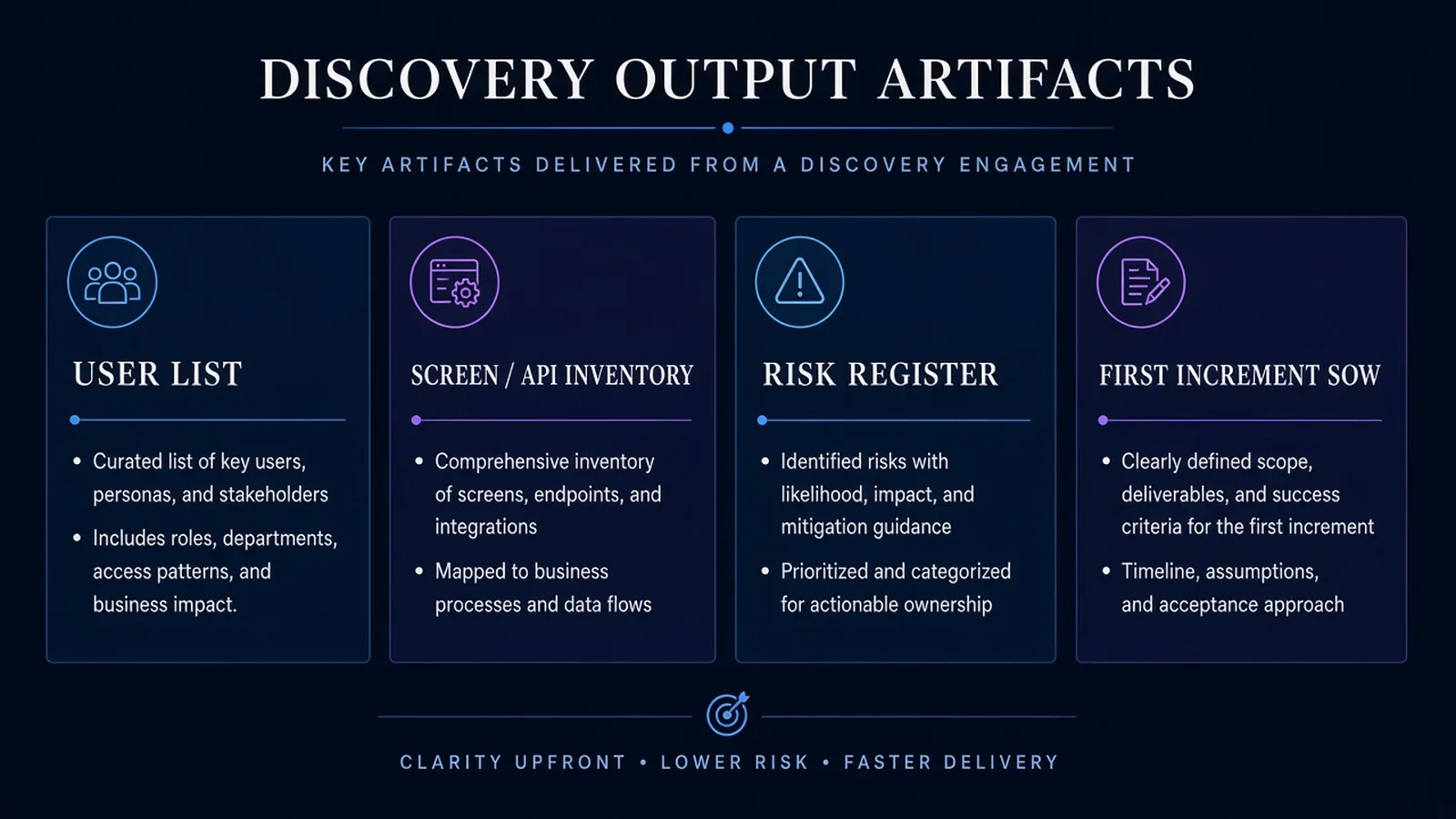
A useful discovery packet is boring and reusable. At minimum:
| Artifact | Why it matters |
|---|---|
| Problem statement and success metrics | Stops "make it like X" from becoming the spec |
| User / role list and permissions sketch | Auth and tenancy are where rebuilds hide |
| Candidate architecture (one page) | Stack, environments, data stores, third parties |
| Risk register | Ranked unknowns with a plan to close them |
| Milestone plan + rough effort | Enough to choose fixed, hybrid, or hourly |
| Draft SOW outline | The build contract should copy from this, not from Slack |
You should also own the notes. If the only output lives in the vendor's head, you paid for a conversation.
How Long It Should Take
For an MVP or a bounded feature slice: one to two weeks, a handful of working sessions, and a written pack. Typical spend is a small fraction of the build - often a few thousand dollars of senior time, not a six-week "inception."
For an enterprise modernization or a system with several legacy integrations: two to four weeks, including access to the current environment and a technical spike on the riskiest connector.
If discovery is quoted as months with a large team, you are buying a program, not a scoping exercise. That can be valid - call it that, and staff it like a project.
When to Skip Discovery
Skip a formal discovery when:
- The work is a repeatable pattern you have done before (marketing site, well-known Stripe checkout, a documented API wrapper).
- You already have a written spec, data model, and environment access.
- You need a time-boxed spike on one unknown (prove the vendor API works) rather than a product definition.
Do not skip it when the sentence "it's just like our current tool, but..." appears, or when AI is involved and nobody has named the source of truth. Demo quality and production quality are different products - see shipping AI features past the demo.
How to Buy Discovery Without Getting Played
- Pay for it. Unpaid discovery is sales. Paid discovery is engineering.
- Name the people. Senior engineers who will (or might) build the thing should be in the room. Account-only discovery is how you get a pretty PDF and a surprised delivery team.
- Cap the hours. Discovery is a not-to-exceed engagement with a date, not an open research grant.
- Require repo and doc handover. Architecture sketches, ADRs, and the risk list go in your Drive or Git from day one.
- Separate the build decision. You are allowed to take the packet and hire someone else. A company that withholds the artifacts to lock the follow-on work is selling a hostage, not a partnership.
Direct contracts help here: fewer platform fees, clearer IP, and a written SOW for the discovery itself. That is the same posture we use on how we work.
Discovery and Contract Shape
Discovery usually runs hourly or a small fixed fee. The build that follows is often milestone fixed price if the packet is tight, or hourly with a cap if the risk register is still long.
That sequence - pay to learn, then pay for a ceiling - is how you avoid the two classic failures:
- A fixed bid stuffed with 30-40% padding because nobody opened the legacy API.
- An hourly start with no product owner, where "figuring it out" is the entire project.
Startups and enterprises use the same idea with different paperwork. Founders need a packet they can show investors. Procurement needs a packet they can attach to a PO. The engineering content is the same; the engagement model around it is not.
FAQ
Will discovery slow us down? It front-loads a week so the next eight do not thrash. Teams that skip it rarely ship sooner; they just start coding the wrong thing sooner.
Can we do discovery ourselves? Yes, if someone can write acceptance criteria, name integrations, and own tradeoffs. Many product teams can. Discovery is for when you cannot, or when an outside company needs to price risk honestly.
What if we already have Figma? Keep it. Pair it with data, auth, and operational constraints. Pictures without a data model are still a guess.
The Bottom Line
Paid discovery is how a software company turns a wish into a contract you can both survive. Buy a packet: risks, architecture, first increment, and a draft SOW. Then choose fixed, hourly, or hybrid with your eyes open.
If the vendor will not sell a small, capped discovery - or will not give you the artifacts - do not buy a large build from them either.
Scoping an MVP, a rebuild, or an AI feature? See Myrafy services or contact us for a free estimate - discovery first when the work is still a question.