
"How much does it cost to build software?" is the most common question in software procurement - and the most honestly answered with "it depends." But that answer is frustrating, so here is a more useful breakdown.
Custom software development costs depend on four variables: complexity, team location, engagement model, and your ability to scope clearly. Understanding each one lets you estimate more accurately and negotiate more effectively.
The Ranges You Will Actually Encounter
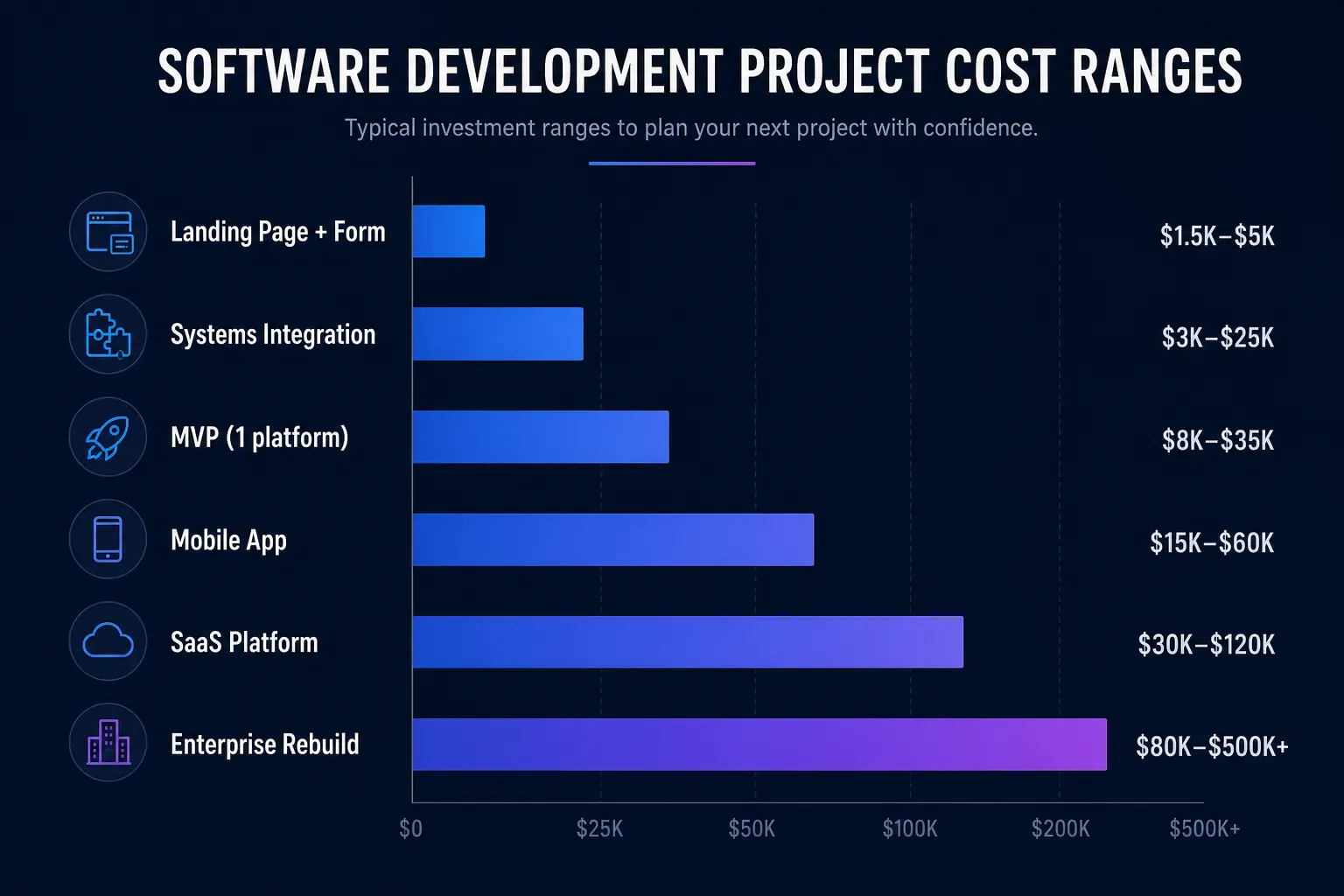
These are real-world ranges based on how projects are quoted by competent engineering teams in 2026, not aspirational marketing numbers.
| Project Type | Typical Range |
|---|---|
| Simple landing page + contact form | $1,500 - $5,000 |
| MVP (core feature set, 1 platform) | $8,000 - $35,000 |
| SaaS product (multi-tenant, admin + API) | $30,000 - $120,000 |
| Mobile app (iOS or Android) | $15,000 - $60,000 |
| Enterprise platform rebuild | $80,000 - $500,000+ |
| AI feature integration | $5,000 - $40,000 |
| Systems integration / automation | $3,000 - $25,000 |
These ranges reflect senior-level engineering, proper documentation, and post-launch support. Significantly lower quotes usually mean one of three things: junior execution, aggressive scope cuts, or a contractor who will disappear after deposit.
What Drives Cost Up
Unclear requirements
The single biggest cost driver in software development is scope ambiguity. When requirements change mid-project - and they almost always do without a proper discovery phase - each change ripples into architecture decisions, test coverage, and deployment logic. A well-scoped project costs less than a poorly-scoped one even when the final output is the same.
Invest 10-15% of your budget in a proper discovery phase: user stories, wireframes, architecture decisions, and a written specification. You will spend that money somewhere - either in planning or in rework.
Third-party integrations
Every external service you connect - payment processors, email providers, CRMs, ERP systems - adds complexity. A checkout flow with Stripe is well-documented and predictable. An integration with a legacy enterprise API that has a 200-page PDF documentation written in 2011 is not. Integrations rarely go smoothly; budget for at least 50% more time than the happy path suggests.
Authentication and security requirements
A public-facing app handling personal data needs proper authentication, session management, audit logging, and encryption. A HIPAA-compliant application needs more. A SOC 2-ready system more still. Security requirements are not optional costs - they are technical facts about what must exist in the codebase.
Mobile vs web
Building for web is consistently cheaper than mobile. Mobile apps require separate builds for iOS and Android (or cross-platform complexity with React Native/Flutter), App Store and Play Store review cycles, device compatibility testing, and different performance constraints. If your users can use a web app, start there.
Real-time features
Notifications, live dashboards, collaborative editing, chat - any feature that updates in real time requires WebSocket infrastructure, state synchronization, and failure-mode handling. Add 30-50% to the estimate of any feature described as "live" or "real-time."
What Keeps Cost Down
Well-defined scope. The tighter the spec, the more accurate the quote, the fewer surprises.
Phased delivery. Ship the smallest useful version first. Get it in front of real users. Use that feedback to decide what to build next rather than speculating upfront.
Offshore senior talent. A senior engineer in India or Eastern Europe charges $40-$80/hour for work that would cost $150-$220/hour in the US or UK. The quality gap between senior engineers across these regions is smaller than the rate gap.
Direct contracts. Hiring through a platform like Upwork adds 10-20% in platform fees that come directly out of either your budget or the engineer's rate. Direct engagements - with a proper contract - are cheaper for both sides.
Fixed-scope milestones. Time-and-materials contracts protect the engineering team from scope creep but not the client. Fixed-scope milestone contracts force both sides to define deliverables clearly and align incentives. Use them where requirements are stable.
Hourly Rates by Region (2026)
| Region | Junior | Mid | Senior |
|---|---|---|---|
| India | $15-$30 | $30-$60 | $60-$100 |
| Eastern Europe | $30-$50 | $50-$80 | $80-$120 |
| Western Europe | $60-$90 | $90-$130 | $130-$200 |
| US / Canada | $80-$120 | $120-$180 | $180-$280 |
| Australia | $70-$110 | $110-$160 | $160-$250 |
These are freelance/contractor rates. Agency blended rates are typically 30-50% higher than the individual developer rates above.
The Hidden Costs Nobody Quotes
Most software quotes cover development. They often do not cover:
- Project management - Who is writing the spec, running the sprints, making decisions? If this is you, that is your time. If it is the team, add 10-15% to the estimate.
- QA and testing - Proper automated test coverage adds 15-25% to development time. Manual QA passes add more. A quote that does not mention testing is a quote that assumes no testing.
- Infrastructure and hosting - Monthly costs for cloud hosting, CDN, database, and monitoring range from $20/month for a small MVP to $500-$5,000/month for a production platform with real traffic.
- Post-launch support - The six weeks after launch are when you find the bugs that testing missed. Budget for a support retainer or bug-fix sprint.
- Domain, SSL, email, third-party services - Stripe, SendGrid, Cloudflare, monitoring tools - each small, but they accumulate.
How to Get an Accurate Quote
A competent engineering team cannot quote your project accurately from a paragraph description. For a reliable estimate, share:
- User types and core journeys - who uses the system and what do they need to do?
- Integrations required - which external systems need to connect?
- Scalability expectations - 100 users at launch? 100,000 by year one?
- Timeline constraints - hard deadlines (fundraise, product launch, contract deadline) change the approach
- Existing code or designs - what already exists that we build on or integrate with?
- Budget range - sharing your budget does not mean you pay the maximum; it means the engineer can tell you what is achievable rather than quoting for a system you cannot afford
The more clearly you can answer these, the tighter and more trustworthy the quote.
The Cheapest Quote Is Rarely the Cheapest Project
An underpriced quote is a negotiating tactic, not a service offer. The work has to cost someone something. A $3,000 quote for a $20,000 project usually means missed scope, junior execution, or a low initial price that escalates with change requests.
Get three quotes. Ask each team to explain their assumptions, what is not included, and what would cause the estimate to increase. The team that answers those questions clearly is telling you something important about how they will communicate once the project starts.
Related reading: Freelance vs Agency vs Software Company and How to Hire Software Engineers in India on a Company SOW.
Myrafy provides detailed written quotes with full line-item breakdowns after a free discovery conversation. Projects start from $2,000. Explore what we build, the OrgPlaza workplace OS, or get a free estimate.