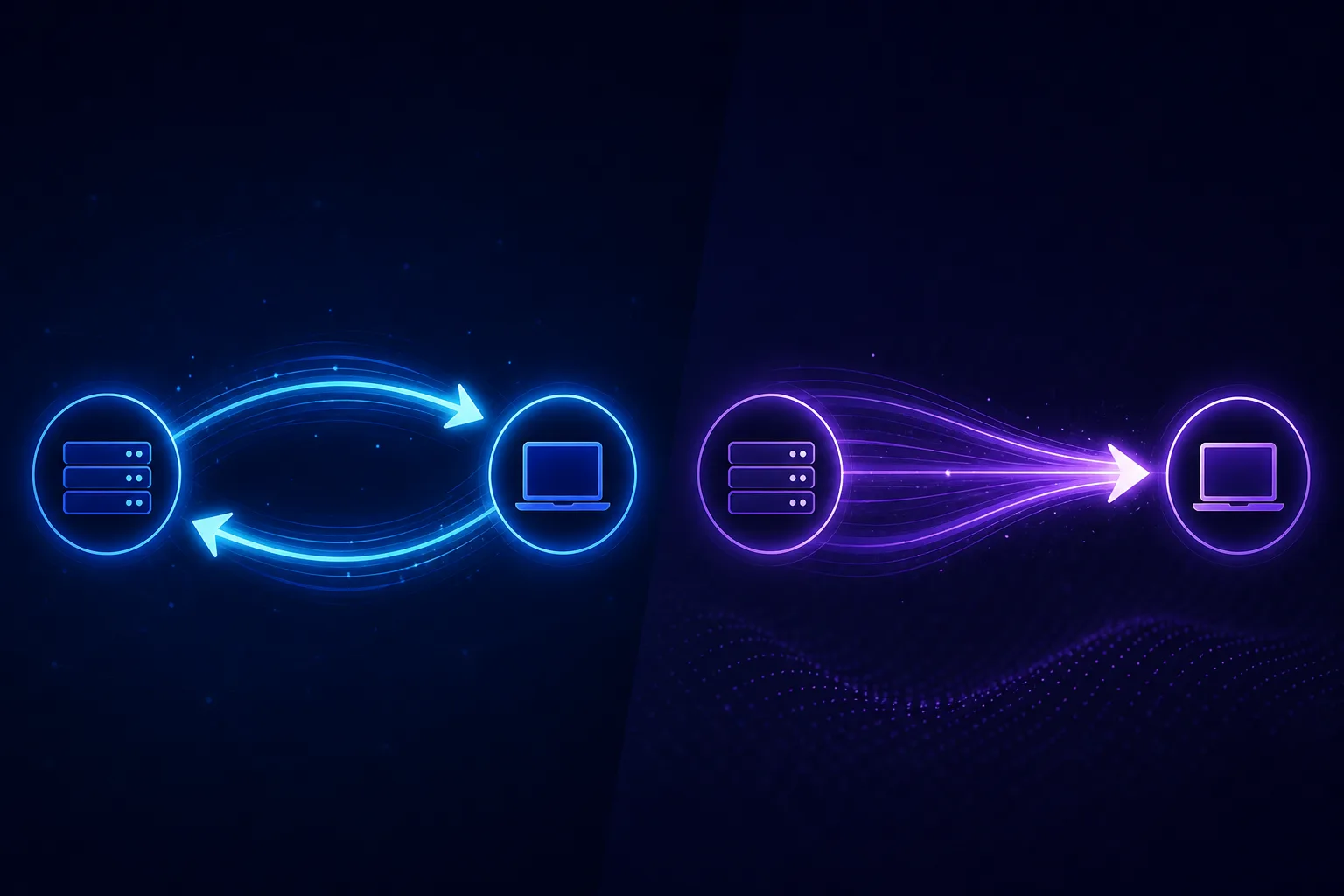
WebSockets vs Server-Sent Events (SSE) is the usual fork when a product needs live updates - dashboards, notifications, collaborative cursors, or token streaming from an LLM.
Both beat short polling for many workloads. They are not interchangeable: direction of data, proxy friendliness, and ops complexity differ. Pick from requirements, not from "realtime" as a buzzword - the same discipline we use for API rate limiting and Next.js server patterns.
Quick Comparison
| WebSockets | Server-Sent Events (SSE) | |
|---|---|---|
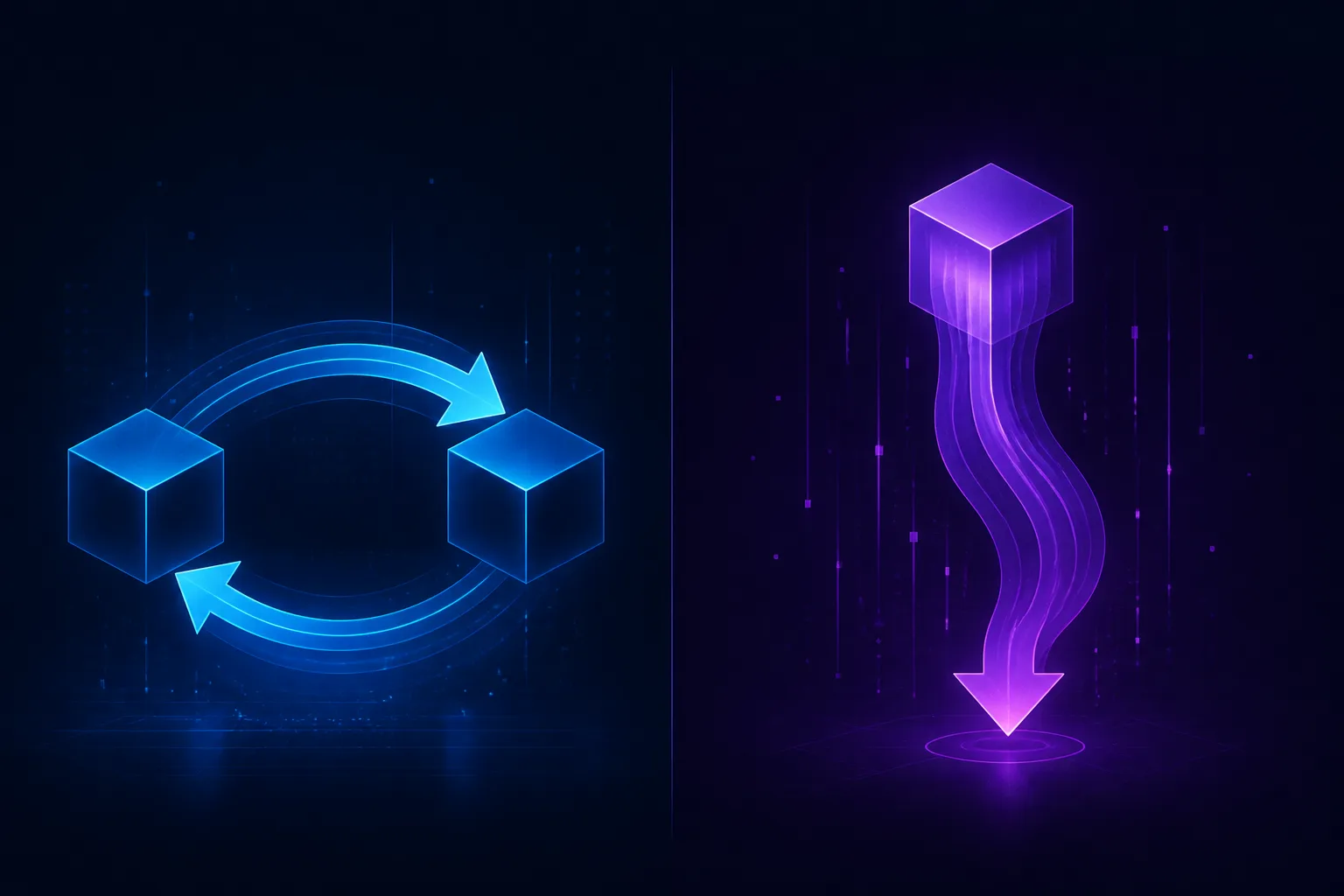
| Direction | Full duplex (client ↔ server) | Server → client (client sends via normal HTTP) |
| Protocol | ws / wss after HTTP upgrade |
Standard HTTP response stream |
| Browser API | WebSocket |
EventSource (or fetch streams) |
| Binary | First-class | Text-oriented (binary needs workarounds) |
| Reconnect | DIY or library | Built into EventSource |
| Proxies / CDNs | Need WebSocket support | Often easier on plain HTTP |
| Typical fit | Chat, games, collab, bidirectional commands | Feeds, notifications, LLM token streams |
When SSE Is the Better Default
Choose SSE when:
- Updates are mostly server → client
- You stream text (logs, notifications, model tokens)
- You want simple auth via cookies on same-origin HTTP
- Your edge already understands long-lived HTTP well
LLM UIs often use SSE or fetch streams: the user message is a POST; tokens flow down one response. No need for a duplex socket if the client is not sending a high-rate event stream back.
When WebSockets Earn Their Complexity
Choose WebSockets when:
- Client must send a continuous or high-frequency stream (presence, cursor, gameplay)
- You need binary frames efficiently
- One long-lived duplex channel simplifies the protocol
You then own heartbeats, backoff, fan-out, sticky sessions or pub/sub, and horizontal scale. Plan Redis (or similar) pub/sub early if more than one server will emit events.
Auth, Scaling, and Infra Notes

Shared concerns:
- TLS everywhere (
wss/ HTTPS) - Auth - cookies on SSE; for WebSockets, validate on connect and periodically
- Backpressure - slow clients must not pin unbounded memory
- Fan-out - publish once; subscribers on each node deliver locally
- Rate limits - apply to connect rate and message rate (rate limiting guide)
Sticky load balancing helps naive in-memory socket maps; pub/sub helps you sleep at night.
Hybrid Patterns
Many products mix transports:
- SSE or stream for AI tokens and notification feeds
- WebSocket for collaborative editing rooms
- Ordinary REST/Server Actions for commands that do not need a socket
Do not force every feature through one realtime pipe.
Common Mistakes
- Using WebSockets for one-way notification feeds "because realtime"
- Forgetting reconnect and resume (last event id / sequence)
- Holding per-user state only in one process with no shared bus
- Skipping auth on the upgrade/connect path
- Streaming forever without idle timeouts or max duration
FAQ: WebSockets vs SSE
Can SSE send client → server? Not on the same EventSource connection. Use POST/fetch (or open a WebSocket if duplex is core).
Is SSE dead because of WebSockets? No. SSE remains a strong fit for one-way streams and is often simpler to operate.
What should I use for ChatGPT-style token streaming? SSE or HTTP chunked/fetch streams are common and sufficient. Use WebSockets if your product also needs rich duplex interaction on the same channel.
The Bottom Line
WebSockets vs Server-Sent Events comes down to duplex vs one-way. Default to SSE (or HTTP streams) for feeds and LLM output; choose WebSockets when the client must speak continuously. Design reconnect, auth, and fan-out before you demo the shiny live UI.
Need realtime or streaming features in a production stack? Explore Myrafy services or get a free estimate.