Azure vs AWS is a real choice for some companies and a religious argument for others. For an SME shipping one product, the expensive outcome is not "picking the wrong logo." It is running both without a platform team, or stalling for a quarter while a committee scores feature matrices.
This is how we choose on cloud and DevOps work. It assumes you already want containers or managed app platforms, not a data-center replica. Pair it with a boring AWS baseline when AWS wins, Terraform so the choice is code, and Docker vs Kubernetes so you do not add a cluster as a side bet.
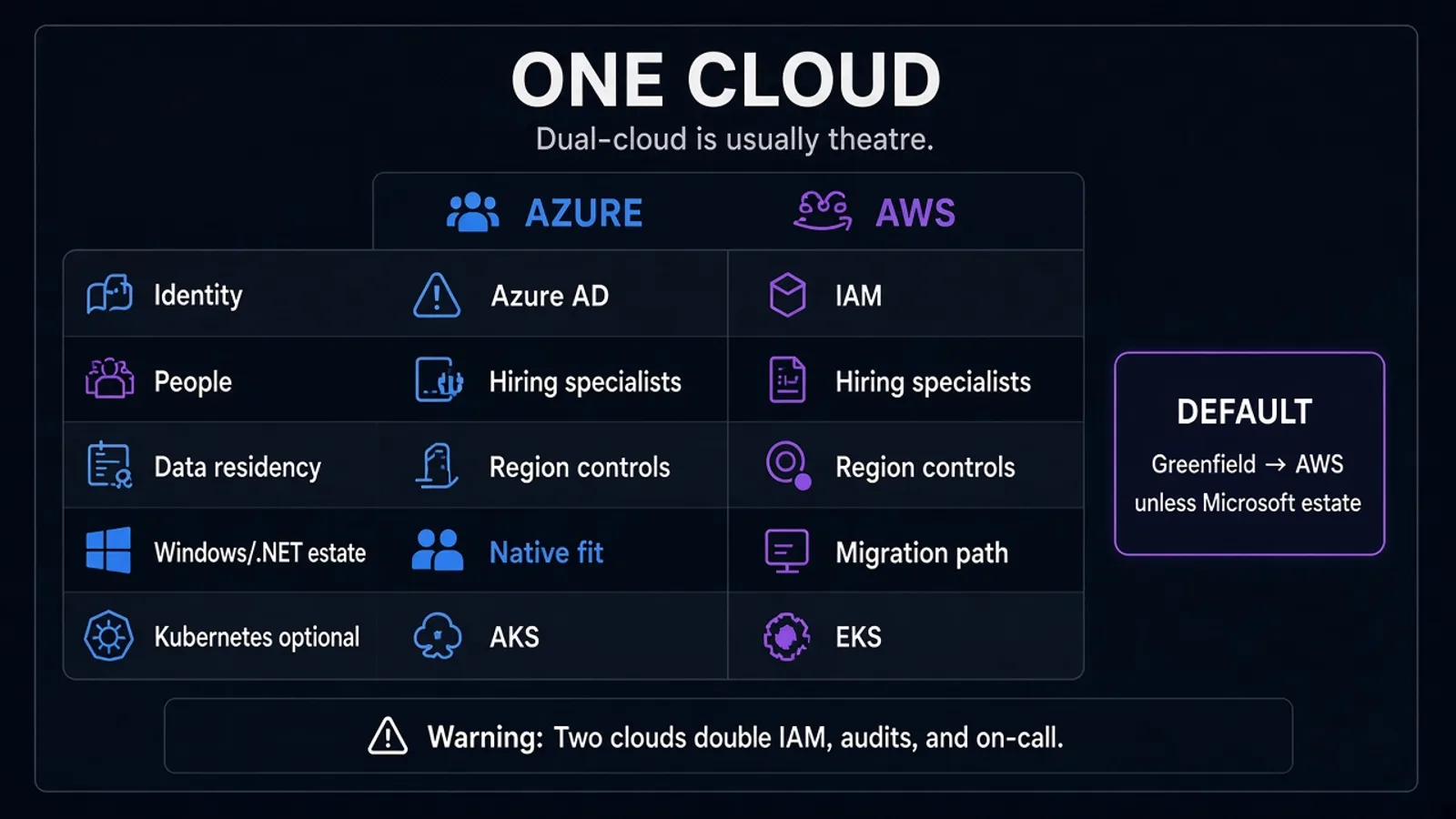
Default: One Cloud, Unless the Estate Says Azure
If there is no existing Microsoft agreement, Active Directory mandate, or in-house Azure skill, we default to AWS for a greenfield product: IAM, networking, and managed databases are well-trodden, and the startup DevOps path is documented to death.
If the company already lives in Microsoft 365, Entra ID, and an Enterprise Agreement, Azure is often the cheaper organizational choice even when a tweet says AWS is "more native." Identity and procurement dwarf the VM price.
GCP is a fine third. We will not pretend you need a bake-off of three to ship an MVP.
What Actually Differs for an SME
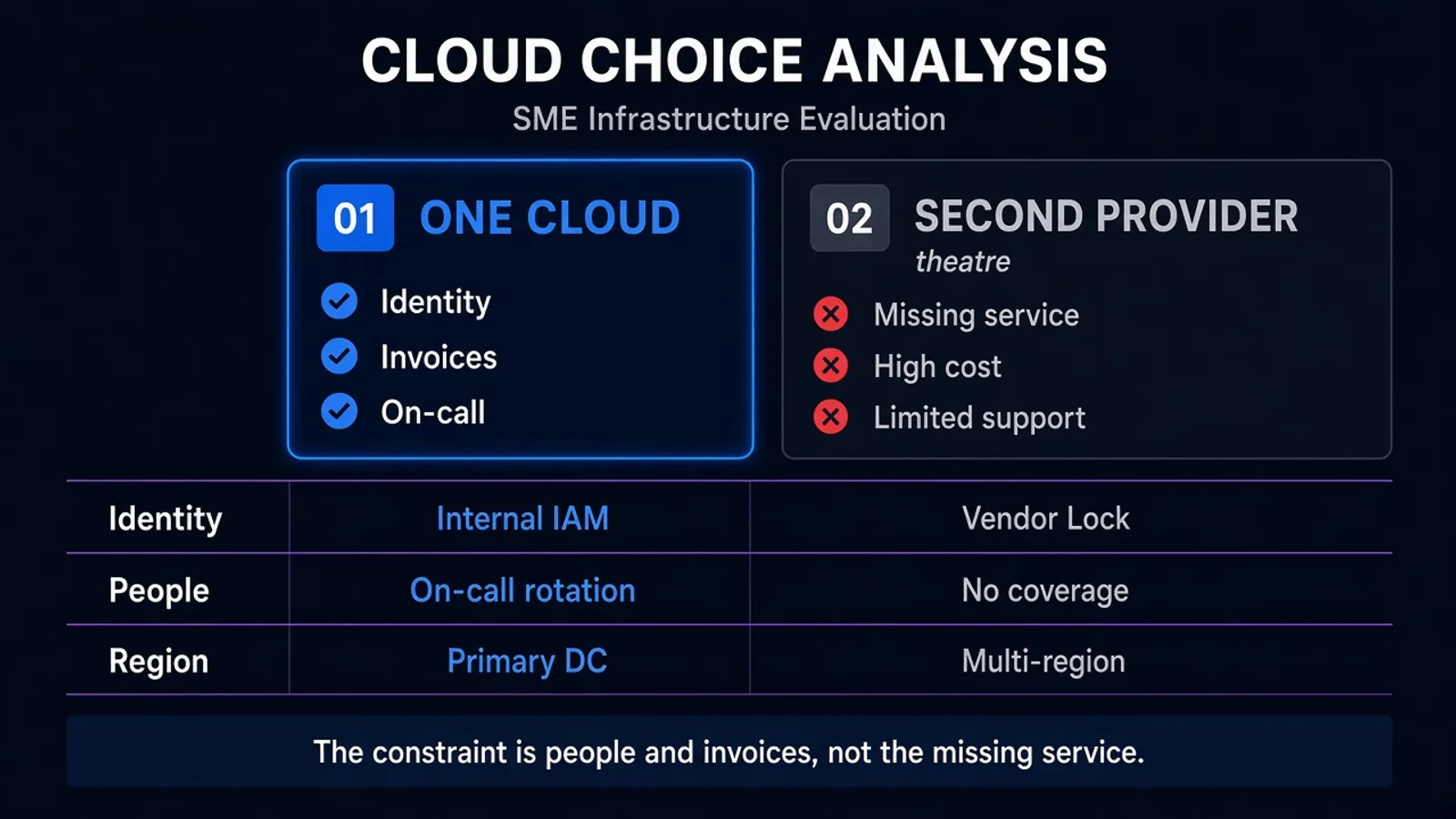
| Constraint | Prefer AWS when | Prefer Azure when |
|---|---|---|
| Identity | You will build IAM from scratch | Users and devices already sit in Entra ID |
| People | Someone on the team has shipped on AWS | Your IT org already opens Azure tickets |
| Data residency / public sector | The workload's region list fits | The buyer already standardized on Azure regions |
| Windows / .NET estate | You can run those on AWS too | You want first-party PaaS next to existing licenses |
| "Best" Kubernetes | EKS is fine | AKS is fine - you may need neither |
Object storage, queues, and Postgres-compatible databases exist on both. Do not pick a cloud because S3 is famous. Pick because your people can debug the bill and the IAM policy at 2 a.m.
Dual-Cloud Is Usually Theatre
Two clouds make sense when:
- You acquired a company and cannot move them this year
- A customer contract names a provider
- You are a vendor whose product is multi-cloud (you will pay for that)
They do not make sense as "resilience." Resilience is multi-AZ, backups you have restored, and a runbook. An app that is "also on Azure" but shares one database and one DNS provider is a slide.
Every extra cloud doubles:
- IAM models
- Audit questionnaires
- The chance that staging is on one and prod on the other "temporarily"
If a consultant sells dual-cloud as default for a 30-person product company, ask who is on-call for both.
A Decision You Can Finish in a Week
- List constraints that are not technical (agreements, identity, region, Windows).
- If one cloud satisfies them, pick it. Stop.
- If neither does, pick the one your engineers have shipped on. Hire or train; do not add a second vendor to hide the gap.
- Express the baseline in Terraform (or Bicep if the Azure team already lives there - one IaC language).
- Put the choice in the SOW so the next vendor cannot "introduce GCP for the AI bit" as a hobby.
AI APIs can stay third-party even when compute is on AWS or Azure. That is a vendor, not a second cloud. Still watch token economics.
FAQ
Will we be locked in? You are locked into somebody's IAM and networking. Containers and Terraform reduce the blast radius. They do not make a rewrite free. Design for portability of data and images, not for a fantasy of flipping a switch.
Is Azure cheaper with credits? Credits are real and expire. Model the bill at list after the honeymoon, including support plans and bandwidth.
Can we use AWS for prod and Azure AD for login? Yes. That is identity federation, not dual-cloud. Keep the compute in one place.
The Bottom Line
Azure vs AWS for an SME is: pick the cloud your contracts and people already understand, go deep, and skip a second provider as a resilience story. Dual-cloud without a platform team is two incomplete setups.
One boring production, restored backups, and a bill someone reads will beat a matrix in a deck.
Choosing a cloud baseline for a product, not a migration programme? See cloud and DevOps or get a free estimate.