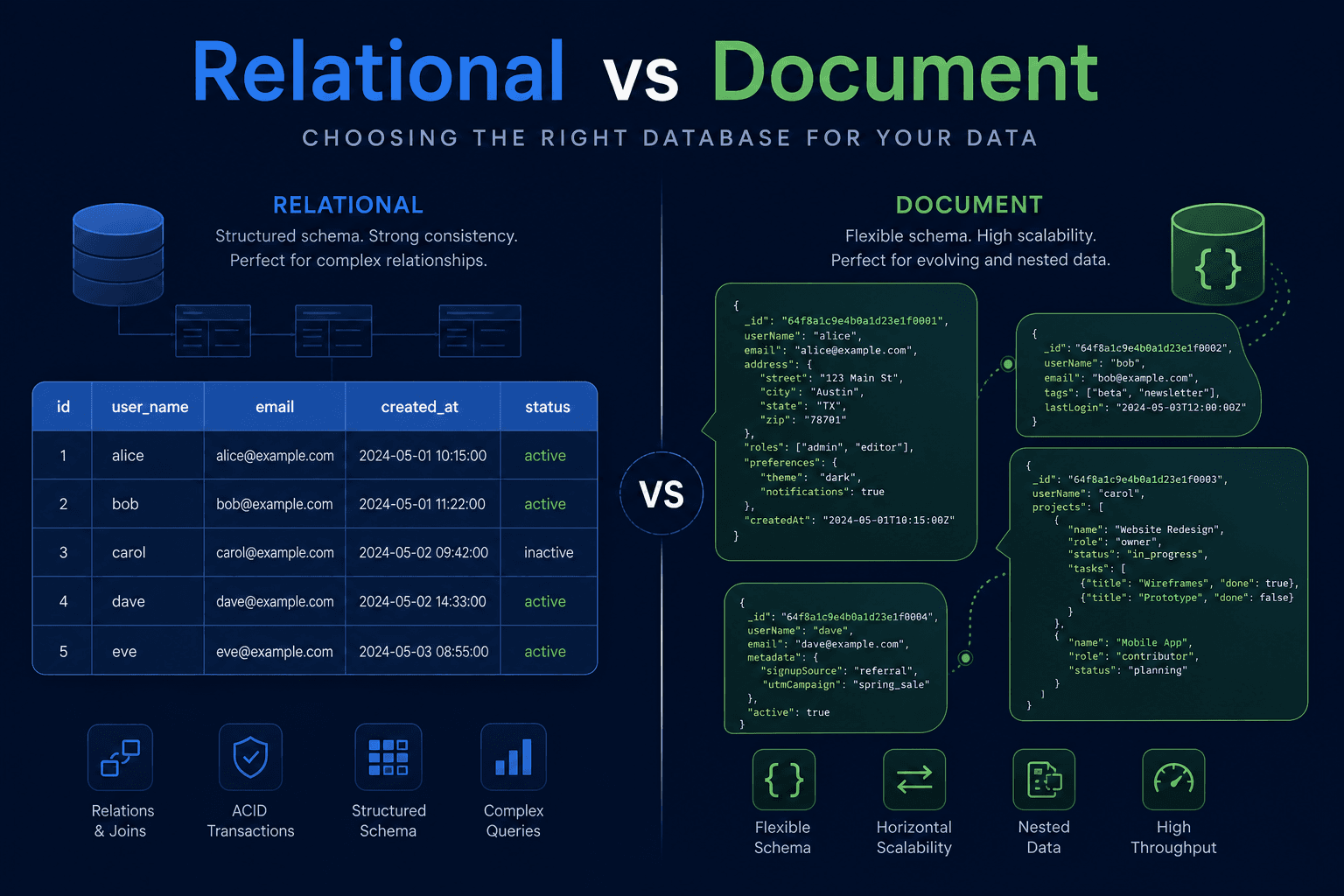
PostgreSQL vs MongoDB is less about "SQL vs NoSQL" branding and more about what shape your data and queries take for the next two years.
PostgreSQL is a relational database with excellent JSON support. MongoDB is a document database optimized for flexible hierarchical documents and horizontal scale patterns. Both can run your MVP. Choosing poorly usually shows up as painful joins, painful migrations, or painful transactions - not as a tweet about modernity.
We pick databases the same way we pick auth and infra: boring defaults first, then exceptions - whether you are designing APIs after JWT authentication or grounding RAG systems with structured metadata.
Data Models in One Picture
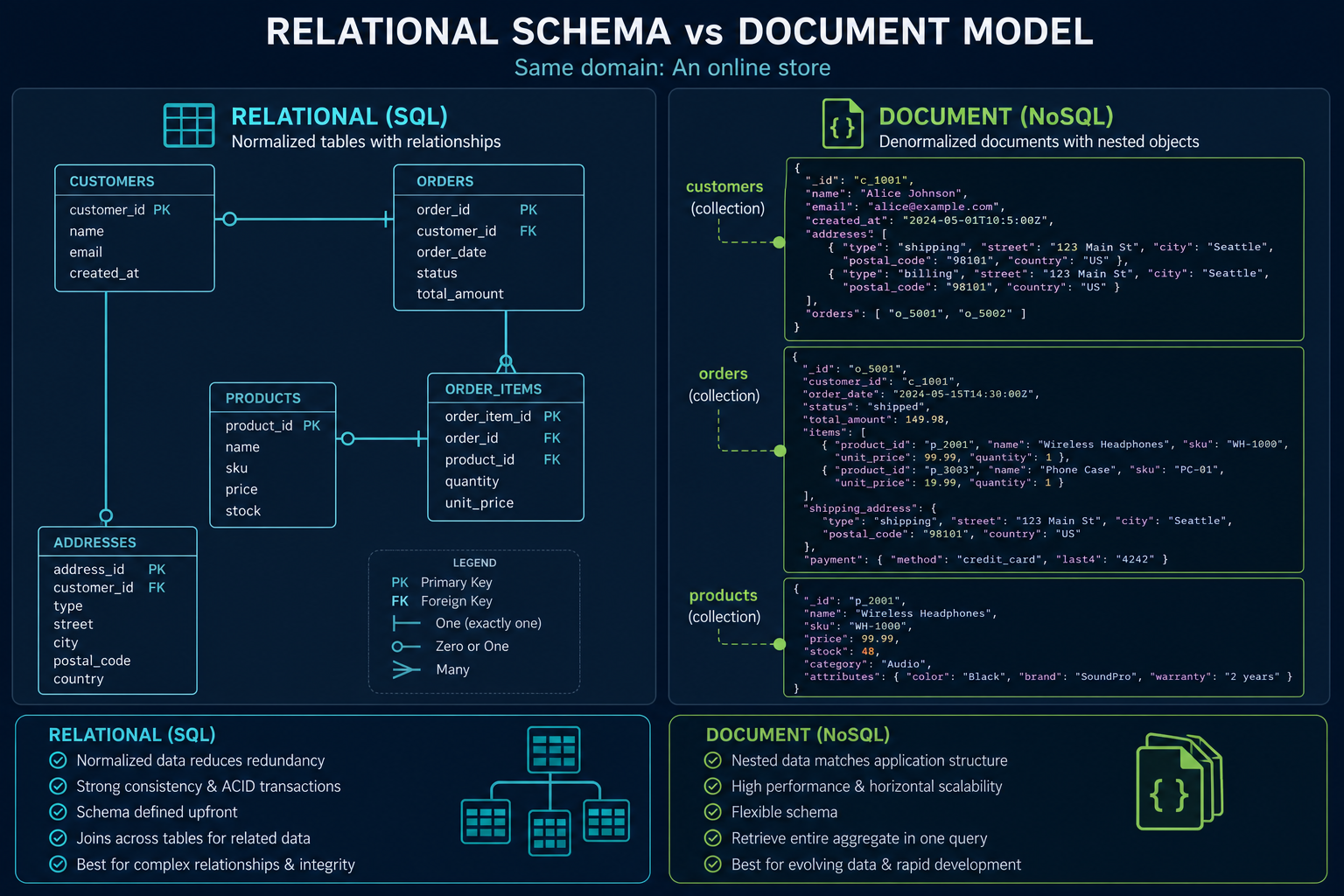
| PostgreSQL | MongoDB | |
|---|---|---|
| Core unit | Row in a table | Document in a collection |
| Relationships | First-class (FKs, joins) | Embedded docs or manual refs |
| Schema | Declared (migrations) | Flexible (validation optional) |
| Transactions | Mature multi-row ACID | Multi-document ACID (with caveats on design) |
| Query style | SQL + indexes | Aggregation pipeline + indexes |
| JSON | jsonb is excellent |
Documents are native |
Rule: if your domain is full of many-to-many relationships, reporting, and strong invariants, start with Postgres. If your primary object is a rich document you almost always load whole, and relationships are shallow, Mongo can fit.
When PostgreSQL Is the Right Default
Choose Postgres when you need:
- Strong consistency across multiple entities (orders + inventory + payments)
- Ad-hoc analytics and joins without a second warehouse on day one
- Constraints that the database enforces (uniques, FKs, checks)
- A single operational database most of your team already knows
- Hybrid needs: relational core +
jsonbfor sparse attributes
Postgres also hosts pgvector for embeddings when you add RAG later - useful if you want fewer moving parts than a separate vector SaaS early on.
When MongoDB Fits Better
Choose Mongo when:
- The product object is naturally a document (CMS pages, catalogs with wildly varying attributes)
- You read/write mostly by primary key or a few indexed fields
- You expect horizontal scale patterns Mongo's ops model matches your team's skills
- Schema evolution is frequent and you will still design indexes deliberately
Mongo is not "schema-free forever." Unindexed queries and unbounded arrays will hurt you as badly as a bad Postgres schema.
Decision Guide
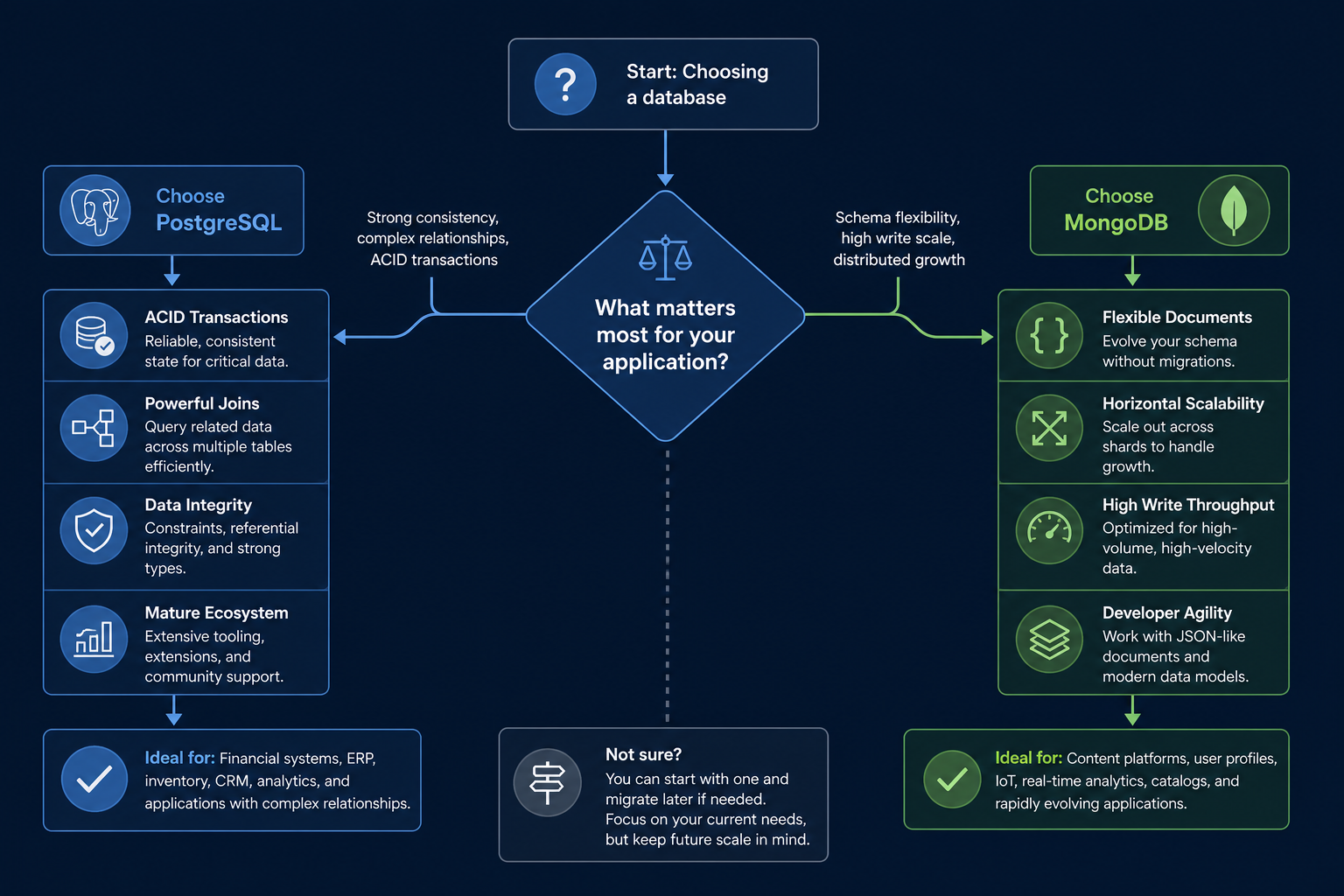
Ask, in order:
- Do money, inventory, or permissions span multiple records that must commit together? → Lean Postgres.
- Is the primary read a nested document you rarely join across? → Mongo is plausible.
- Will non-engineers run complex reports in SQL? → Postgres.
- Is your team's ops experience already deep in one engine? → Bias to that skill unless requirements forbid it.
You can run both (polyglot), but that doubles backup, monitoring, and mental load. Prefer one primary OLTP store until scale forces a split.
Performance and Ops (Honest Version)
- Indexes matter more than the logo. Wrong indexes make either database slow.
- Postgres vertical scale + read replicas covers a huge range of SaaS products.
- Mongo sharding is powerful and operationally heavier - don't adopt it for fashion.
- Backups and PITR are non-negotiable on both; test restores.
Managed offerings (RDS/Aurora, Atlas, Cloud SQL, Flexible Server) remove undifferentiated toil. They do not remove data modeling.
Common Mistakes
- Picking Mongo "because JSON" while Postgres
jsonbwould have been enough - Picking Postgres then storing giant unstructured blobs with no relational benefit
- Skipping migrations / validation and calling it agility
- Modeling Mongo like normalized SQL (or Postgres like a document dump)
- Ignoring connection pooling and transaction boundaries under load
FAQ: PostgreSQL vs MongoDB
Can Postgres replace Mongo for documents?
Often yes via jsonb + GIN indexes - especially when you still need relational integrity around the edges.
Is Mongo faster? For the right document workload with the right indexes, it can be excellent. For join-heavy relational work, Postgres usually wins. Benchmark your queries.
What about for AI / RAG? Store chunks and metadata where your ops are strong. Postgres + pgvector is a strong early default; dedicated vector DBs appear when scale or features demand them - see our RAG architecture guide.
The Bottom Line
PostgreSQL vs MongoDB is a product decision: invariants and access patterns beat brand narratives. Default to Postgres for most transactional SaaS; choose Mongo when the document model is genuinely primary and your team can operate it well.
Choosing a data stack for a new product or migration? See Myrafy software development services or talk through an estimate.